
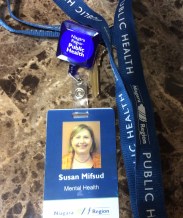
 Since returning to school and focusing much of my M.Ed. studies on mental health education, I have had the goal of transitioning to a new career that includes working in the field of mental health. Through my volunteer work with Canadian Mental Health Association – Niagara I have had the opportunity to meet many individuals who are living with mental illness. While we each have our own unique experiences, there is often a connection on a visceral level as our struggles and successes resonate with someone else who has “been there.” I recognize that I am not a clinician with respect to mental illness, but I have felt that a peer-to-peer relationship can provide a special kind of support.
According to the Mental Health Commission of Canada, peer support is proven to be both an effective and cost efficient method of assisting individuals living with mental illness (http://www.mentalhealthcommission.ca/English/issues/peer-support): “Empowerment and the development of personal resourcefulness — the foundation of peer support — not only improves people’s lives but also saves money by reducing the use of more formal mental health, medical, and social services.”
So, when I saw that The Niagara Region’s Public Health department was advertising for a Recovery Support Worker in the Mental Health Unit, I was excited about the possibility. The Assertive Community Treatment Team (ACTT) is designed to assist individuals with the most serious and persistent mental illness, including schizophrenia and bipolar disorder. Individuals supported by this service often have co-existing problems such as homelessness, substance abuse or involvement with the judicial system.
I excitedly applied for the role in November of last year, and was sure that the position had been filled when I received an email invitation to interview in mid-March. I felt very positive about the interview and the Managers who were on the hiring committee and was beyond thrilled to be offered the job a few weeks later. I accepted with great enthusiasm and more than a little nervousness; I would be both new to this job and to the field of direct service in the mental health field.
My start date quickly arrived – it felt like the first day of school. The night before I woke up every hour, checking the clock fearing I might oversleep. I consciously completed my work attire with earrings and a necklace that had been given to me by people I love, thereby creating my own Linus blanket and providing me with a little comfort to assuage my nervousness. My car seemed to know exactly which way to drive after spending so many years travelling to Brock University for work and, more recently, for school; I just had to remember to turn left just a bit sooner to make my way to the Region.
My anxiety was quickly lessened as I was greeted by welcoming colleagues. My day began with the regular team meeting, followed by a whirlwind tour of the Welland and Niagara Falls sites, and the opportunity to accompany one member of my team on her client visits in the afternoon. I was struck by how she connected with each of the individuals in a caring and respectful manner. While I felt overwhelmed by my own inexperience working directly with clients in a mental health setting, I was confident I was in the right workplace.
The following two days I travelled to Welland to job shadow with the other Recovery Support Worker who was the original peer support person on the team and had chosen to work in Welland where she lived when the second ACT team was created there. She had been in her role for the last 10 years, and had previously worked with CMHA. I was awed by her calm, caring approach to everyone she met, and her connection with the clients she visited. I was thankful to have the opportunity to observe her while she worked, and especially for the time she took to talk with me about the role, her approach and the importance of peer support. I was grateful for her kind words of encouragement when I expressed my fears about being able to provide worthy support and connection to the people I would be serving and to adequately represent the perspective of individuals living with mental illness on the team.
As I write this blog, I have completed my first week at my new job. My brain is full each evening, but so is my heart. I know I have a lot of learning still to do, and that I am privileged to have been given an opportunity to work in this capacity; I will endeavor to earn the trust I have been given by fulfilling the role to the very best of my ability, providing support, empowerment, and hope to those who are in need.
Next up: 50 Fabulous Feats: The Workshop!
 best selves. It is not surprising, therefore, that when I began my own consulting business, I was drawn to coaching and mentoring as a possible niche. But, even though I had lots of practical involvement from my previous work, I was concerned that I didn’t have specific education in coaching; I didn’t want to give less than the best experience for people who might want to hire me as a coach.
 (
( Day 2 began with an individual review of our scripts by Sam which allowed me time to chat with the woman who was sitting beside me. The Universe does work in mysterious ways and it turned out that she and I had many things in common, including a passion for supporting mentally healthy individuals. It was wonderful to talk to her about her experiences and the opportunities she was exploring and I have no doubt that she will bring magic and healing to the world.
 Writing, by its nature, can be a pretty insular experience. While the final product is shared with others, the process of creation is an individual labour (of love, but hard work nonetheless). For me, the challenge is further heightened by a somewhat (who am I kidding, a fully developed) perfectionist approach to the task. One of the reasons I chose to write via a weekly blog format was because of my tendency to ruminate over my writing, resulting in lots of revisions, but very limited actual output. Being committed to writing and sending out a weekly blog means letting go of my obsessive editing in favour of regularly pressing the publish button. Now more than half way through my 50 Feats, I am much less critical of my work. Where I would have obsessed about typos and other missteps in the past, I can now gratefully accept the occasional email from a friendly reader pointing out a small “oops,” edit and update, and…let it go.
 ittle of what being outside on a cold winter night is like. With an estimated 150,000 Canadians experiencing homelessness outside, and countless more facing the uncertainly of living right on the edge, the walk raises both awareness and much-needed funds in over 100 communities for people struggling with poverty, mental health and addiction issues, discrimination, homelessness, and unemployment.
 This feat is inspired by The Semicolon Project. In 2013, Amy Bleuel wanted to pay tribute to her father, whom she had lost to suicide. Amy adopted the semicolon as a symbol to promote discussion around mental illness. The tattoo of a semicolon represents a sentence the author could have ended, but chose not to. Amy’s message is that that we are all authors, and the sentence we choose to continue, after taking a pause, is our lives. Since its beginnings, the Semicolon Project has become a global movement (www.projectsemicolon.org) that represents hope and love for those who struggle with mental illness, suicide, addiction, and self-injury.
 ted 54 friends and family to her home and raised $1,200 for the Moncton branch of the Canadian Mental Health Association.
 invited 3 local speakers from the CMHA Speakers’ Bureau to share their stories and welcomed just over 100 guest who enjoyed a glass of wine, some appetizers and the companionship of like-minded, caring women.
 and counters. If you build it, they do come, beginning with a trickle of early birds at 5:45 and rising to a tsunami just after 6:00. The buzz in the lobby foretold the success of the evening. When doors to the main room opened, the women (and a few brave men) were escorted to their seats. Each table was decorated with green napkins representing mental health and a beautiful flower arrangement from Vermeers. In addition to wine available at the bar, cider, hot appetisers, and an assortment of desserts were set out on the tables.
 female performers brought this collaborative piece to life: stories of bi-polar disorder, post-partum depression, abuse and post-traumatic stress disorder; the shame resulting from the stigma of mental illness, the pain that makes living feel intolerable; and, most important, the hope of support, help, and recovery. There were few dry eyes at the end of their delivery as we all connected at the heart, thinking about our own struggles and those of our friends and family members.
 Berezowski and has a membership of over 170 women. The idea behind 100 Women is to provide funds to local community causes by coming together for an hour at 4 times during the year and donating $100 per person on these occasions to a selected Niagara charity. In a single hour, 3 charities that have been nominated by members are randomly selected and their representatives provide a brief explanation of the cause and how monies will be used if chosen. Members then vote and one of the charities wins the donations for that meeting.
 ployment in) professional positions, did not indulge in nose bling.
 on the fabric. It seemed like an oddly specific warning.
 I have developed in my “new life.”
 SilverLiningFrog